Maribor: a Travel Guide to Slovenia's second city
The first time I walked through Maribor, I expected a provincial town. I got a centre with wine cellars under my feet, street art on medieval walls, and cafés on the Glavni Trg where you can sit for two hours without anyone bringing the bill.
A city beneath the world's oldest grapevine
Maribor is Slovenia's second city. 95,000 inhabitants, on the Drava in the northeast. It was European Capital of Culture in 2012, a student town thanks to the university, and the Pohorje mountain plateau is 30 minutes' drive to the south. That's the skeleton.The soul sits in the combination: a centuries-old wine tradition next to a food culture quietly reinventing what Štajerska tastes like.
Bled is the highlight of Slovenia, Ljubljana is the capital. Maribor is where you go when you have time for a second week.
What are Maribor's Top Sights?
The Stara Trta: world's oldest grapevine
In the Lent district, against the wall of a house on Vojašniška ulica, grows the Stara Trta (the Old Vine). According to Guinness World Records this grapevine is over 400 years old, which makes it the oldest still-producing vine in the world. It's a žametovka (modra kavčina), a blue grape common across Štajerska.
What you don't picture: how ordinary it looks. No monument, no fence, no admission fee. Just a vine with thick, twisted branches, at eye level. Next to it sits the Stara Trta house, a small museum where you get the story and, if you're lucky, a taste of the wine the vine still produces every year.
Practical: the museum is open daily in high season, free to view, a few euros for the tasting.
Tip from our expert: The Old Vine Festival takes place in early September. This ten-day festival is the city’s premier wine festival. Every spring, the vine is ceremonially pruned. Cuttings are then given to selected partners to help spread the rich heritage.
The Lent District and the Lent Festival
Lent is Maribor's oldest neighbourhood, pressed against the Drava. Narrow streets, dark brickwork, a handful of terraces along the quay, and the vine as its anchor. In June and July the whole stretch turns into the grounds of Festival Lent: theatre, music, dance, open air, two weeks straight. Outside the festival, it's quiet, and you can sit at Restavracija Mak on the river with good local food and affordable wine.
Glavni Trg and the Plague Column
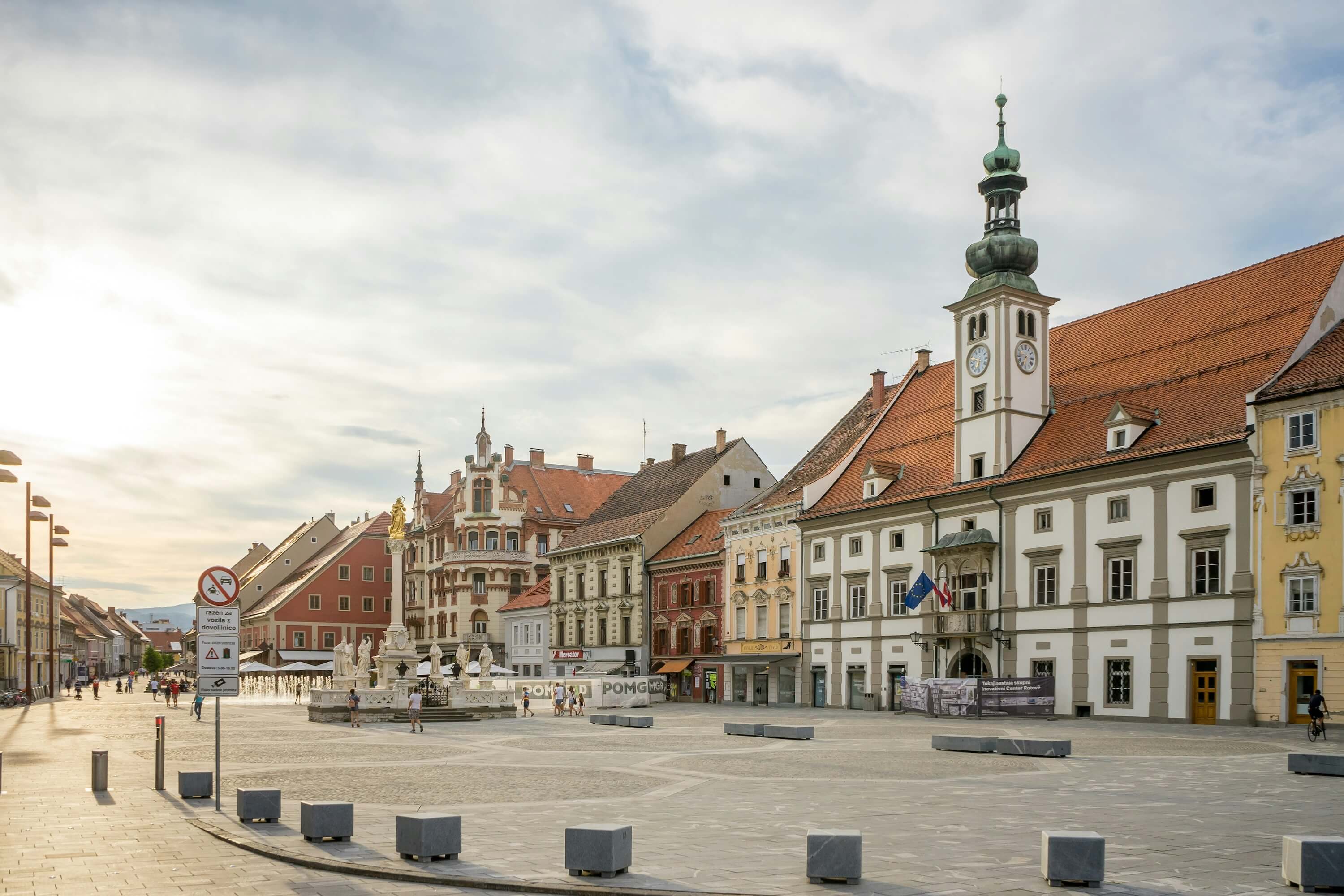
Glavni Trg (the Main Square) is a wide baroque plaza, ringed with cafés and the city theatre. At the centre stands the Plague Column from 1743, built when the plague finally left the city. On Wednesday and Saturday mornings the adjacent square (Glavni Trg-North) becomes a market: cheese, honey, bread, autumn vegetables when the season is right. Not the most photogenic market in Slovenia, but one where you actually come home with something.
Mariborski Grad: the regional museum
The city castle (Mariborski grad) stands on the east edge of the centre and houses the Pokrajinski muzej Maribor. Not a classic card-catalogue museum: you walk through themed halls (archaeology, folk art, the 20th century) and end on the loggia with a view across the city and the Pohorje on the horizon. Plan for an hour and a half if you look slowly.

Tasting the Wine of Štajerska in Maribor and the Haloze
The Vinag cellar beneath the city
Beneath a large slice of the centre runs the Vinag cellar: over 20,000 square metres of underground storage in tufa tunnels. Vinag is not a small boutique label. It's a co-operative that makes wine for much of the wider region. Tours run through the Maribor tourist office, take about 90 minutes, and end with a tasting of four wines. €20–€35 per person depending on the tasting.
What to try here: Šipon (the Slovenian name for Furmint), Laški Rizling and Renski Rizling. Don't confuse Laški Rizling with Italian Riesling: it's its own grape, drier, with more texture. For those who enjoy more complex wines, ask after the vintages from cellar section 3. That's where the archive wines sit.
Small winemakers in the Haloze Hills
Half an hour east of Maribor, the Haloze hills roll towards the Croatian border. A cluster of small winemakers there will receive you directly at the table: a glass in your hand, their vineyard in your sightline, and almost no tourists for miles. Two addresses worth the detour: Dveri-Pax (a winery in a former monastery) and Ptujska Klet (the oldest still-active wine cellar in Slovenia, since 1239).
Tip from our wine expert: don't visit more than two or three winemakers in a day. Štajerska is not Brda; here they take their time, and it would be a shame to miss three conversations in half a day.
Where should you eat in Maribor?
Styrian cuisine is authentic and traditional. Hungarian paprika, Austrian potatoes, Slovenian comfort food. If you want to sample the traditional cuisine, you’ll find pork, sauerkraut, and turnips, beans, eggs, sour cream, cottage cheese, grains, and/or potatoes on your plate. Order a potica (a walnut-filled pastry) sometime, a few štruklji (rolled dough parcels filled with quark or pumpkin), or jota in the winter (a soup made with sauerkraut and beans). Nothing exotic, everything honest.
Beyond the city: Pohorje, Ptuj and the Thermal Spas
Pohorje Mountains: biking, running, skiing
The Pohorje is a forested mountain plateau that begins directly south of Maribor. In summer it's one of Slovenia's best mountain biking destinations: dozens of kilometres of marked trails, from green to black, with lift service in season. The annual Marathon Pohorje (May) draws around 3,000 participants. For runners there are quiet forest tracks with modest elevation, ideal for those who want to move without Triglav-level ambition. In winter the Pohorje becomes a small ski area with artificial snow; for serious skiing, everyone moves on to the Julian Alps. From the centre of Maribor you take the Pohorje Vzpenjača, the old cable car, which gets you to the top in ten minutes.
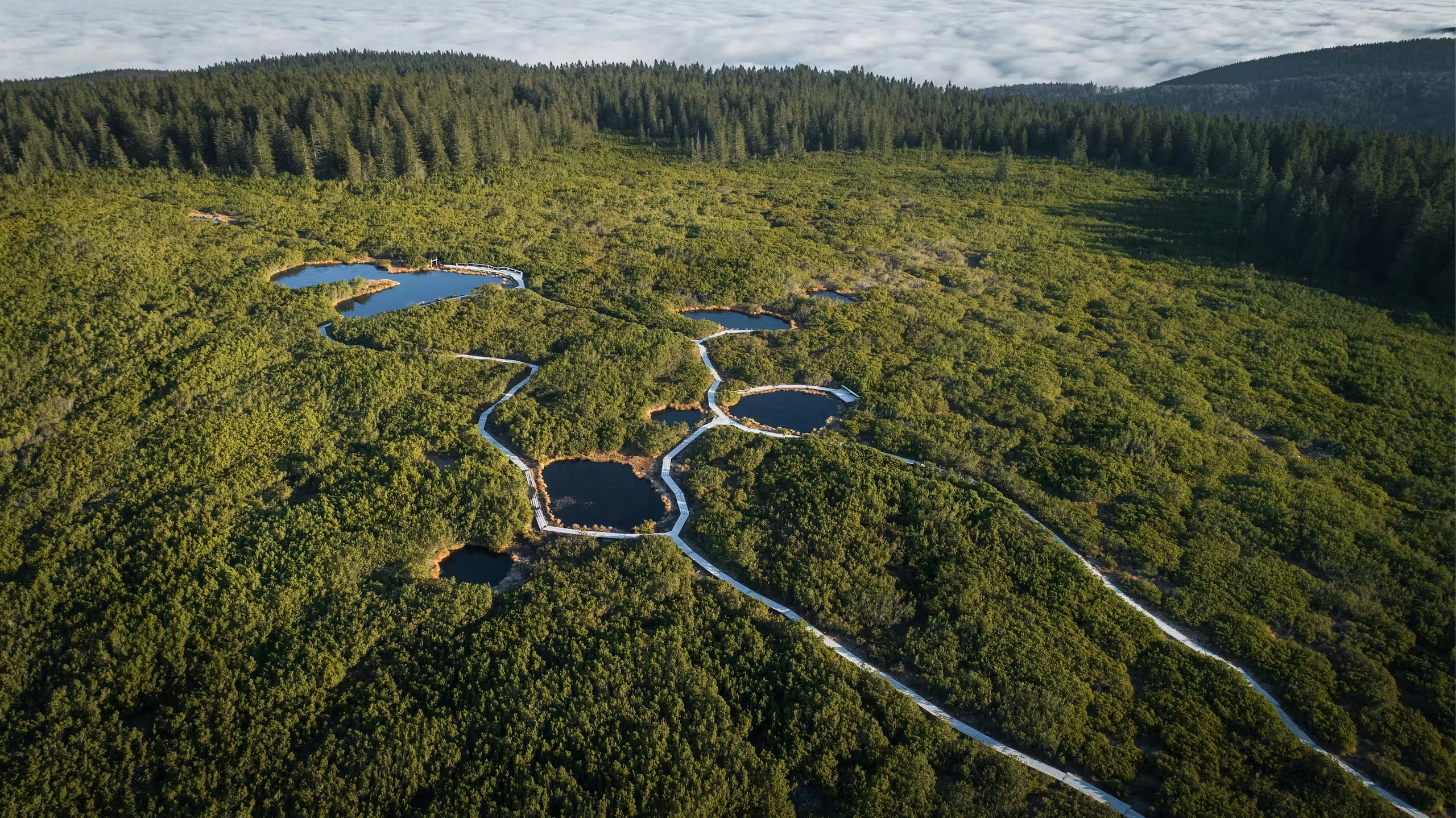
Tip for adventurers: visit Lovrenška jezera, a unique high-altitude moorland area with 20 small lakes on the Pohorje mountain range.
Ptuj: Slovenia's oldest city
Ptuj sits southeast of Maribor and, according to historians, is the oldest city in Slovenia, with Roman and early-medieval traces reaching into the centre. It's small, car-light, and the castle above the town has a good museum on the Kurentovanje, Slovenia's pre-Lent carnival, where locals dress as wild Kurent figures. Outside February Ptuj is quiet; in February it's busy enough that you'd want to book a room ahead.
Terme Maribor and the Thermal Baths
On the edge of the city sits Terme Maribor, a classic Slovenian thermal spa with outdoor and indoor pools, a sauna complex, and a hotel attached. The water is naturally warm, mineral-rich, and the basins are generously laid out. For something deeper: Terme Laško (60 minutes southwest) and Terme Olimia (50 minutes southeast) are larger and older, with more of the historic spa architecture intact.
Practical tips for visiting Maribor
How to get here?
- By car: 2 hours from Ljubljana via the A1/A4, a fast hour from Graz (Austria). Parking in the centre is not a problem; use the Glavni Trg or Sodna ulica garages for the most central spots.
- By train: the direct connection Ljubljana–Maribor takes about 2.5 hours and costs around €12 one way. Not the fastest option, but a pleasant one.
- By air: Maribor has its own airport (MBX), but barely any scheduled flights. If you fly, fly into Graz (1 hour by car) or Ljubljana (1.5 hours).
How long should you stay?
Two to three days is enough to see the city well without feeling rushed. Day 1: the centre, the Stara Trta, the Glavni Trg, the Mariborski grad. Day 2: the Vinag cellar and half a day in the Haloze. Day 3: the Pohorje or Ptuj. A week, and you combine it comfortably with Brda or Ljubljana.
When to go?
May through October is the strongest season: warm, dry, the festival calendar full. September is probably the most beautiful month: harvest time in the vineyards, autumn colour on the Pohorje, and the tourist density of July gone. December is good for the Christmas market on the Glavni Trg, cold and cosy. July and August are the busiest months; unless you're coming for the Lent Festival, you can skip that window.
Where to sleep?
The centre is small enough to do everything on foot, so staying near the Glavni Trg or in the Lent is the most practical choice. Three options to consider:
- Hotel Maribor City: mid-range, in a restored townhouse on the Glavni Trg, from around €90 per night.
- Hostel Pekarna: a former bakery, now a hostel with its own cultural programme. Cheap, young crowd, fine for a night or two.
- Hiša Denk: outside the city in Polana. Boutique, one Michelin star in the restaurant below. For when you want it really quiet.
More option can be found on Visit Maribor.
The world's oldest grapevine grows in Maribor, and the city beneath it is well ahead of its reputation.
Frequently Asked Questions
- Is Maribor suitable for families with children?
Yes, especially for older children from seven or eight onwards. The centre is car-light and compact, there are playgrounds on Trg Generala Maistra, and the Pohorje with its cable car and summer toboggan is a good day out. For very young children, Maribor isless of a fit than, say, Bled with its little lake and easy boat ride. - How much does a wine tasting cost?
Small winemakers in the Haloze: €5 to €15 for 3 or 4 wines. Vinag: €25 to €35 for a tour with tasting. Restaurant glass: €3 to €8 for local wine, more for rare vintages. - Can you touch the Stara Trta?
Officially no. There is a low barrier in front of it. But you can stand well within a metre, take photos, and visit the tour next door. Anyone who does reach in for a touch gets a polite but firm warning from the staff. - Do people speak English?
In hospitality, hotels, and attourist attractions, yes. In small cafés, taxis, and with older people at the market, not always. A few words of Slovenian (Hvala = thank you, Dober dan =good day) is much appreciated.
Last verified: May 2026 | last updated: May2026 | Author: Editorial Team Mijn Slovenie
Bronnen: Visit Maribor, Pokrajinski muzej Maribor, Guinness World Records, Slovenian Tourist Board, Mijn Slovenie